OSHA Severe Injury Reports
The Occupational Safety and Health Administration (OSHA) has required employers to report all severe work-related injuries since
Jan. 1, 2015.
The OSHA severe injury data reported here is a summary of the information made public by OSHA and differs from the Bureau of Labor Statistics (BLS) data presented elsewhere on the Injury Facts website. BLS nonfatal data are based on the Survey of Occupational Injuries and Illnesses (SOII) and provide statistically representative estimates of workplace injuries and illnesses for the U.S. workforce for all OSHA reportable cases. By contrast, the OSHA severe injury data are specific to establishments required to submit data, are not representative of the entire United States and focus on amputations, hospitalizations and loss of an eye. Only 29 states with federal OSHA programs are represented, further limiting the scope of the OSHA severe injury data. The 27 states and two territories with an OSHA state plan are not included in this dataset.
Benefits of OSHA Severe Injury Data
OSHA severe injury data tend to be more recent (available through March 2025), while the most recent BLS data reflect 2023. Data for specific establishments also are available through the OSHA severe injury program, while no establishment-specific data are available from BLS. It’s important to remember, however, that BLS data systems are designed to provide statistically representative estimates of workplace injuries and illnesses for the U.S. workforce, and the OSHA data system is not intended to provide statistically representative estimates.
Using the Visualization Below
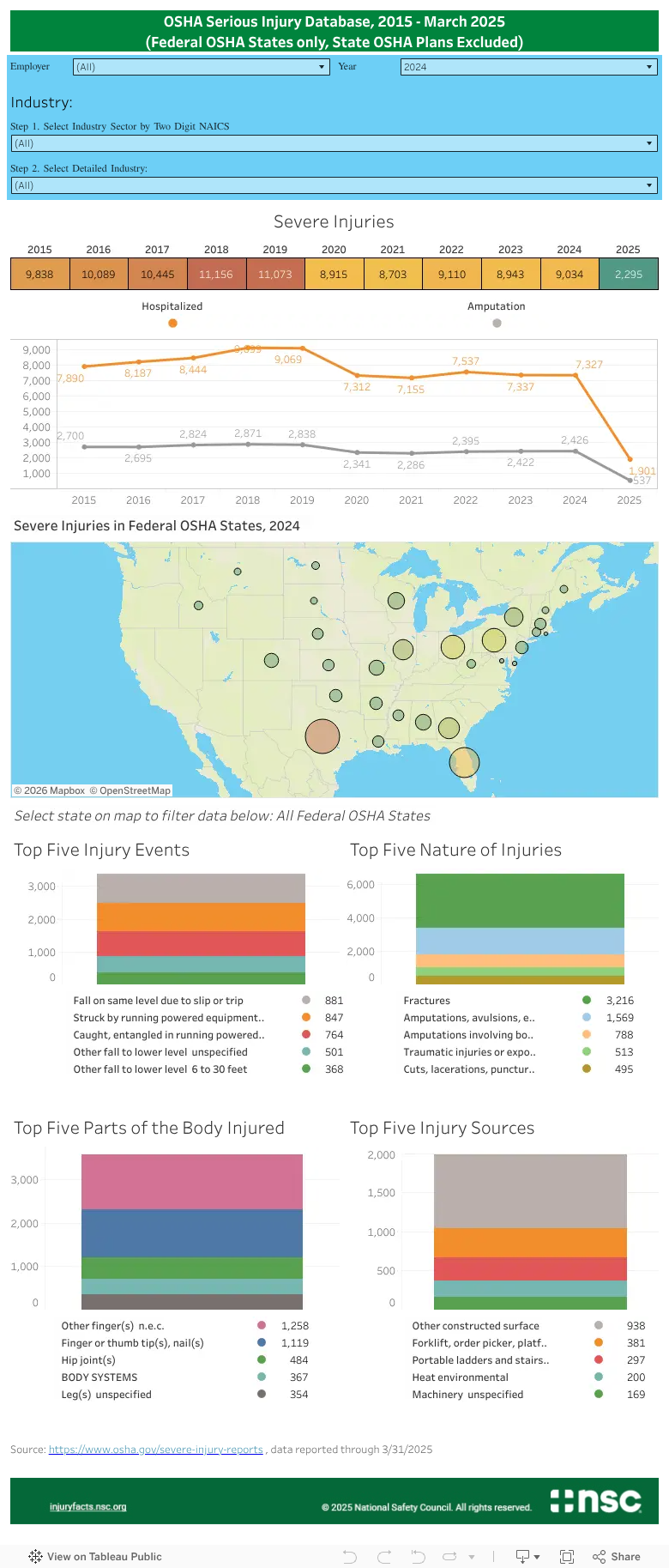
Injuries are coded using the Occupational Injury and Illness Classification System. Filter the data by year and for specific industries using the North American Industry Classification System (NAICS). Click a state on the map to filter the data by that state. You can also filter by employer name.
The number of severe injuries reported to OSHA peaked in 2018, with 11,156 cases. There were 9,034 cases in 2024, the last full year of data, representing a small increase from 2023. The most frequent injury event in 2024 is fall on same level due to slip or trip, followed by struck by running powered equipment. The most frequent nature of injury is fractures, followed by amputations. The most frequent body part injured is other finger(s) not elsewhere classified, followed by finger or thumb tip(s), nail(s). The most frequent injury source is other constructed surface.